Hospitals & Asylums
Customs (ID)
To amend Chapter
5 Columbia Institution for the Deaf, to appoint a civilian Customs
Commissioner, CIA Director and Secretary of State who is not a lawyer, to
dissolve Homeland Security in separation of Customs and Domestic Emergency
Management functions to turn a profit for the Treasury and rename Title 6 of
the United States Code, Title 6 of the Federal Code of Regulations and the
Department from “Domestic Security” to “Customs”, to reduce the price of a work
visa from $2,500 to $500 tax withholding and issue tourist visas for free
regardless of nationality, to limit Foreign Service Exam accreditation to
people with a BA in International Relations, to achieve the UN Millennium
Development Goals, to levy a 1% payroll tax for international development, to provide food,
vaccines, antibiotics and other necessary medicines and tents to everyone, to reform voting in the Bretton Woods institutions to a
one person one vote system, to use the IMF Special Drawing Right (SDR) as the
international reserve currency, to appreciate developing nation currencies to
sell American goods, to ensure US demographic statistics are included in the UN
Demographic Yearbook, to adopt the HA federal budget and developing nation
currency appreciation as the only financial recovery plans likely to succeed,
to respect only legitimate governments and people who balance their budgets, to
amend Title 22 Foreign Relations and Intercourse (a-FRaI-d) to Foreign
Relations (FR-ee), to change the name of the Court of International Trade of
the United States (CoITUS) to Customs Court (CC), to refocus US Aid from
security to relief of the poorest, to terminate financing the Israeli/Egyptian
US military finance race, to cease obstructing Palestinian statehood, to
purchase a quota from an Afghan Opium Agency, to terminate all international
offices of the DEA, to hold NATO and UN peacekeeping mission war profiteers
accountable for their crimes, to terminate the UN Peacekeeping Mission in Haiti, to expel the prosecutors from the Hague, to pass the European
Constitution or repeal the European prosecutor to protect the global economy
against further military coup under Monroe doctrine non-entanglement in
European colonial affairs and to ratify the UN Charter Legitimate Edition (UNCLE)
Be the
Democratic and Republican (DR) Two Party System Dissolved
1st
draft Election Day 4 November
2003, 2nd 20
December 2004. 3rd 20 September 2005, 4th
20 September 2006, 5th
6 August 2007, 6th 31 August 2009, 7th 20 September 2010,
8th 16 September 2011
1.This revision of Chapter 5
Columbia Institution for the Deaf Title
24 US Code §231-250 may be cited the Hearing
AID Act. The Columbia Institution for the Deaf
and Dumb was established on February 16, 1857. An Act of Congress, that changed
the institution's charter, enabling it to issue college degrees, was signed
into law by President Abraham Lincoln (1809-1865) in 1864. The school for the deaf became the teaching hospital of Howard University Medical
School in 1868 when it was renamed Gallaudet University in honor of Thomas Hopkins Gallaudet
(1787-1851), a notable figure in the advancement of deaf education, and is endowed as Education for the Deaf. I. King Jordan was elected President of
Gallaudet University (1988-2006) amid student protests for a deaf leader. It is this demand side approach that will
defend us against neo-colonialism as this work supplies the path to peaceful
and prosperous civilian world government that is freely elected by people
around the world on the same day, administers social security style benefits to
the world’s poorest people and truly promotes the freedom of expression. In the meanwhile, the international military
criminal coup in contempt of the judgment regarding the NATO bombing of
Yugoslavia of the International Court of Justice in the Hague has willfully
seized and sabotaged both the United Nations and European Union (EU). The EU economy will be legally incompetent
until the Union passes a Constitution or abolishes the European
prosecutor. The United States must
terminate financing for NATO misconduct and adopt the HA budget HA-28-2-10. The World Food Programme (WFP) seems to
direct all the international economic cooperation, these days, with the moral
support of the High Commissioners of Refugees and Human Rights. The UN will be insolvent until the prosecutor
is involuntarily removed from The Hague and cannot be depended on to tax, until
they cease abusing military power, start respecting State of the art law and
ultimately ratify the civilian UN Charter Legitimate Edition (UNCLE)
2. As the world changes from the 20th
century, the American Century, to an Indo-Chinese democracy in the Third
Millennium, the level of academic study of foreign relations in the U.S.
foreign service – the diplomacy – needs to be protected against soldiers,
lawyers and taxmen by means of limiting Foreign Service Exam accreditation to
people with a Bachelor’s degree in international relations. Existing staff can learn how impoverishing
academic scholarship is and more conventionally educated generations of foreign
servants would achieve higher levels of sovereign immunity. For the vast majority of history,
international relations was seen through the blood red glasses of realist theory,
that studies the balance of military power and the shifting alliances between
nation states. Those who contested the
realist theory, that to the victor go the spoils, were disregarded as
idealists. The great Greek philosopher
Plato lamented, there could be no world peace without a world government to
arbitrate disputes. Traders and
entrepreneurs however made their dangerous way across long voyages and although
of interest to rulers, were not considered of much account to international
relations, a story written by kings, emperors and generals. In the enlightenment however, the
significance of mercantilism, colonialism and finally the beginning of world
government, led to new theories of international relations, not entirely
reliant upon military force.
Functionalism values functional literacy whereby world institutional
government and conferences write multilateral treaties, set uniform
international rules and arbitrate disputes.
Dependency theory attempts to predict and counsel the behavior of States,
in international relations, on the basis of their commercial and economic ties,
such as imports and exports, infrastructure, welfare administration and so
forth. Modern international affairs and
world political economy are rhetorically far more advanced than the nation
states they rule but institutionally, without a legitimate civilian government
or tax administration, is dysfunctional and any progress tends to be undermined
by an equal part of realism that must be fined to benefit the poor.
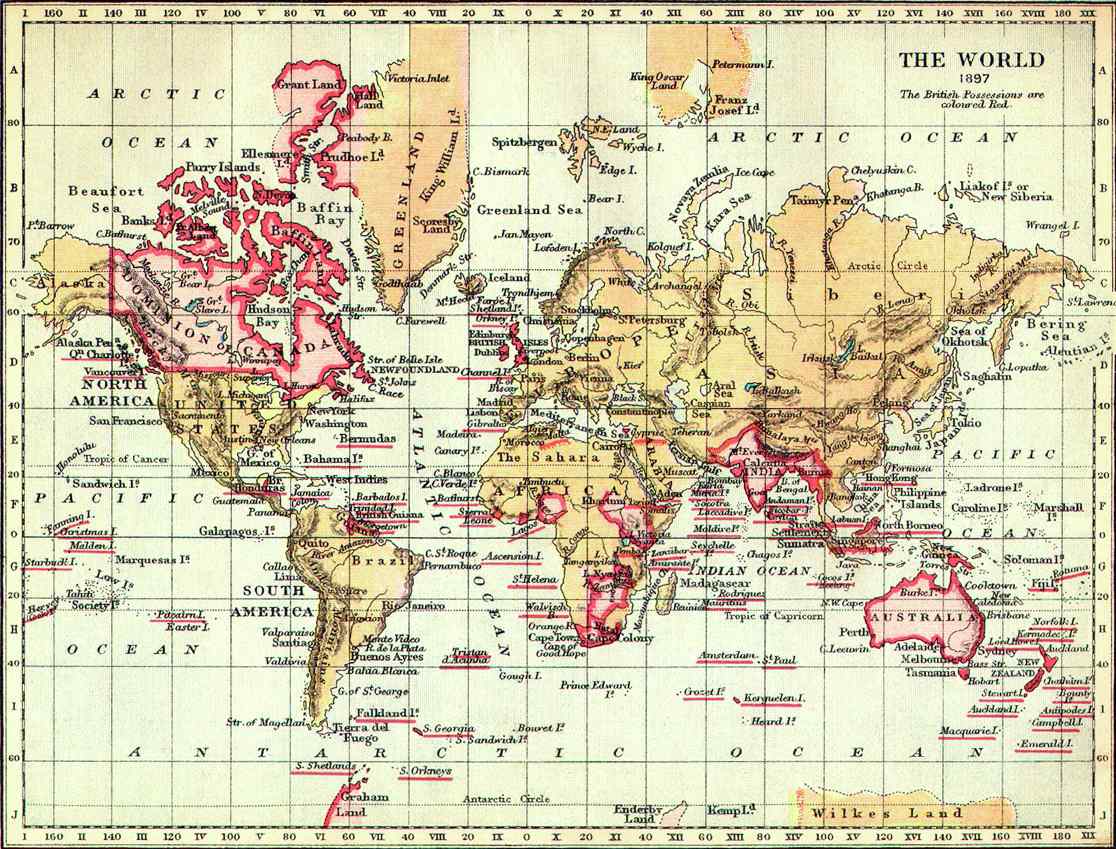
Map of British Empire 1897
3. International relations has
become more optimistic, going so far as to establish an international
government in the 20th century, that empowered by massive advances
in technology and population control, was the most violent century in
history. So far these World Wars have
been the only stimulus for the establishment of world government, which has
decidedly taken on the form of a military dictatorship, in its second
attempt. The International Telecommunication
Union was founded in 1865 as the International Telegraph Union, and the
Universal Postal Union was established in 1874. Both are now specialized United
Nations agencies. In 1899, the International
Peace Conference was held in The Hague to elaborate instruments for settling
crises peacefully, preventing wars and codifying rules of warfare. It adopted
the Convention for the Pacific Settlement of International Disputes and
established the Permanent Court of Arbitration, which began work in 1902. The League of Nations was however not founded
until the First World War, and was formally established as a world government
in 1919 under the Treaty of Versailles "to promote international cooperation
and to achieve peace and security" that also created the International
Labor Organization. Although President
Woodrow Wilson was intrinsic in founding
the League, the isolationist tendencies of the Monroe Doctrine, perversely
codified in 1924 as Title 22 Foreign Relations and Intercourse (a-FRaI-d), kept
the United States out, while Russia for ideological reasons and Germany for
legal reasons, were excluded. The League
of Nations ceased its activities after failing to prevent the Second World War.
In 1945, representatives of 50 countries met in San Francisco at the United
Nations Conference on International Organization in San Francisco to ratify a
sabotaged copy of the Charter prepared in the Dumbarton Oaks, Washington Conversations on International Peace and Security
Organization, where the United
Nations was formulated and negotiated among international leaders from August
21, 1944 through October 7, 1944. United States. The
United Nations officially came into existence on 24 October 1945. United Nations Day is celebrated on 24
October each year.
4. The UN Charter was written at
the height of the bloodiest conflict in history and although it has the
military might the League lacked, it continued to censure Germany and most
significantly, as a military dictatorship, was hard pressed to create a
legitimate government based upon the power of taxation, but it was a document
of its times. In 2005 a UN Democracy
Fund was created and at the World Summit that year it was resolved to amend the
UN Charter wherefore an entirely new UN Charter Legitimate Edition (UNCLE) was done on 28
February 2009. The general principle of the Revision is to set down the General of the
United Nations (GUN) and elect a Secretary of the United Nations (SUN) in general
elections around the world on the same day.
The term organ is changed to branches.
The General Assembly is changed to Assembly. Economic and Social Council (ECOSOC-k) is
changed to Socio-Economic Administration (SEA).
The permanent membership to the Security Council is abolished. A 1% income tax is levied for wealthy nations
to administrate social security like benefits to poor individuals in least
developed countries and finance development.
The Trusteeship Council is repealed and replaced with a Human Rights
Council. So that the money does not
continue to be persecuted under Article 66, some Chapters and Articles have
been renumbered and the Preamble now enforces Chapter IX as appears to have
been the intention of the original author, before the San Francisco conference
sabotaged it. To ratify this Charter
before it is brought before a referendum of all the people in the world, a
Conference is called for, to purchase the rights from HA. The rationale for reform is that the design
of the United Nations as a military dictatorship is un-parliamentary under Art.
20 of the International Covenant on Civil and Political Rights.

5. While
the United Nations has been fairly successful at reducing the number of
casualties of war income inequality, poverty and death from preventable disease
in developing nations has increased. For
the majority of its existence a Cold War was waged between the two superpowers,
the Soviet Union and the United States, realist theory premised upon nuclear
holocaust kept the two nations from a direct war but numerous conflicts were fought
in third world countries, often with devastating results To wage an unjust war in Vietnam after a just
war the United States created the unintelligible USAID Bureau of Asia and Near
East (ANE) that needs to be divided into the culturally sound Bureaus for
Middle East and Central Asian (MECA) and South East Asia (SEA). On the bright side more than 80 nations
gained their sovereign independence from colonial rule under human rights
treaties and overall the number of extremely poor people has decreased over the
past century. Near the conclusion of the
Cold War the Court of International Trade of the United States (CoITUS) was
created in the Customs Court Act of 1980, a sort of ultimate weapon that is
responsible for HIV/AIDS epidemic, a serious development crisis in the 1980s,
slump in the 1990s and world economic crisis in 2008, soaring incarceration and
divorce rates in the United States, thusly catalyzing the dissolution of the
Soviet Union in 1991. To fill the void,
the European Union was created to balance the power of the United States, but
strong military ties under NATO prevented competition so they joined forces for
a new era of colonial domination, first a neo-liberal globalization of trade
that caused a slump in developing nation currencies and donations to Official
Development Assistance (ODA) causing many HIV/AIDS and war stricken African
nations to backslide into poverty. Then
a neo-conservative military ideology took hold and NATO conquered and occupied
Afghanistan and Iraq, without proper Security Council authorization. The retaliatory spikes in the price of oil
broke the decadent industrialized colonial economy that continues to neglect to
discipline the coup of 2006 that took the life of WHO Director General Lee
Jong-wook (Korea). The subsequent global
economic and financial crisis has raised the bar on unpaid and badly abused
economic research, to balance a global budget it is no longer enough to add,
you now also need to do calculus, eg. Devaluate industrial nation currencies in
appreciation of developing nation currencies to meet economic demands.
6. Economic growth declined 0.8% in 2009. It was the first global downturn since the
1930s. The food and fuel crises in
2007-2008 and the global financial and economic crisis of 2009 pushed 100
million people in low-income countries into poverty as a result of a doubling
of food prices. The number of hungry
people worldwide rose from 842 million in 1990-1992 to 873 million in 2004-2006
and to 1.02 billion people during 2009, the highest level ever. The IMF assures us that global economic
recovery is stable with 1.7% growth in the first quarter and 3.2% in the second
quarter of 2010. The credit crisis
affected both industrialized and developing nations. Its primary characteristic was a panic
amongst foreign occupying powers, who, struggling with high oil prices and
opiate relieving pain and social breakdown from the conquerors of the Soviet
Union, spuriously decided to nationalize several banks, squandering the
sovereign immunity from bankruptcy on the large banking corporations the prior
administration laundered his funds with, at great expense to the free
market. The side effects of the bank
nationalizations valued at $4 trillion in 2009, and $1 trillion in 2010, were
immediate massive flights of capital from the stock markets, quickly leading to
layoffs and high unemployment, negative economic growth and record government
spending and budget deficits valued at 7% of GWP in 2009. By strengthening industrialized currencies,
instead of devaluating to offset the printing of money, the crisis was not only
devastating to international trade, that dropped 25%, but spread to developing
nations, who without the resources to bail out their financial sectors nor a
social safety net for the unemployed, could not compete. 83 of 211 reporting nations exhibited
negative GDP growth. The biggest GDP
losses of 2009 occurred in Eastern Europe, Latvia (-17.8%), Lithuania (-15%)
and Estonia (-14.1%), Ukraine (-14.1%), Moldova (-7.7%) and Russia (-7.9%). Many major economies exhibited significantly
negative economic growth, Finland (-7.6%), Ireland (-7.5%), Mexico (-6.5%),
Japan (-5.3%), Germany (-5.0%), United Kingdom (-4.8%), and Italy (-4.8%),
United Arab Emirate (-3.5%), Canada (-2.5%), the United States (-2.4%), France
(-2.2%) and Greece (-2%). The United
States reported the biggest loss in dollar value, a GDP $342.24 billion less
than in 2008, Japan came in second losing $29.26 billion and Russia came in third
losing $167.16 billion.
|
Primary Indicator |
1990 |
2005 |
Goal |
|
Goal 1: Halve Poverty <$1 day |
45.5% |
21.5% |
22.75% |
|
Goal 2: Universal Primary
Education |
82.0% |
89.0% |
90.0% |
|
Goal 3: 1.0 Gender Ratio in
Education |
0.89 |
0.96 |
1.00 |
|
Goal 4: Reduce Child Mortality 2/3 |
9.3% |
6.7% |
3.1% |
|
Goal 5: Reduce Maternal Mortality
3/4 |
430 |
400 |
143 |
|
Goal 6: Halt & Reverse Spread
of AIDS |
8 |
33.3 |
< |
|
Goal 7: Halve Lack of Access to H20 |
77% |
87% |
88.5% |
|
Goal 8: Develop Global Partnership |
52.7 |
107.1 |
> |
|
Sources: UN Millennium Development
Goal Report 2009 |
|||
7.
International economic cooperation has gained focus around the UN Millennium Development
Goals, the MDGs, which aim to halve extreme poverty, defined as less than $1 a
day, and affiliated health and development issues, by 2015. Aid flow statistics to developing nations
first began to be compiled by the Development Assistance Committee of the
Organization for Economic Cooperation and Development (OECD) in 1959 and a
United Nations Development Program was established in 1965. Until the world financial and economic crisis
nearly every developing nation was on target to achieve the MDGs, but this goal
has been jeopardized. At least 60 developing countries will suffer negative per
capita income growth in 2009. Only 7
countries — down from 69 countries in 2007 and 51 in 2008 — will register per
capita growth of 3 percent or higher this year. Growth of 3 percent is
considered the minimum required to achieve significant reductions in poverty. Growth
forecasts for developing countries in 2009 stood at only 1.2 percent compared
to 7.7 percent in 2007. Between 1990 and 2001, the proportion of people living in
extreme poverty (less than 1 dollar a day) in developing countries declined
from 28 to 21 percent, i.e. by 129 million people. Under the Millennium Development Goals it is
set to decline to 10% (622 million people) by 2015. In 2005 843 million people, 12.5%
of the world population, in developing and transition countries continued to be
hungry and over a billion lived on less than a dollar a day. In
2009 GWP contracted 0.8% and the number of hungry people is estimated to have
risen to 18% (1.2 billion people) and the percent who live in extreme poverty
less than $1 a day has risen to 22.9%. The only MDG indicator that has been
substantially achieved is Goal 6 to stop halt and reverse the HIV/AIDS. It
will be a major challenge to provide 600 million people with income and food
security at a cost of $600 million a day, $219 billion a year, by 2015, when
ODA is predicted to achieve the $200 billion a year level.
International
Assistance 1990-2010

8. MDG Goal 8 Clause A.C., calls for “more generous ODA for
countries committed to poverty reduction”.
ODA has been the most efficient measurement of international economic
cooperation. ODA fell out of use during the
neo-liberal 1990s, growing only 10.5%, from $52.7 billion to $58.3 billion,
over the 12 years till 2002, 0.8% annually.
Then, awakened to international
responsibility by the global conflicts in Afghanistan and Iraq, ODA grew
rapidly, with the objective of achieving
the MDGs, to $69.1 billion in 2003, 18.5% growth, plus $33 billion from the
Madrid Conference on the Iraq Reconstruction Fund - $97.13 billion annual
total. In 2004, ODA rose to $79.4
billion,14.9% growth, to $107.1 billion
in 2005, phenomenal 35% growth. In 2004
commitment to a $1 trillion decade for 2015 was reaffirmed and in 2005 regular
assistance rose to $105 billion. In
2005, donors committed to increase their aid at the Gleneagles G-8 and UN
Millennium -5 summits. The pledges made
at these summits, combined with other commitments, implied lifting aid from
USD80 billion in 2004 to USD 130 billion in 2010. Aid however dropped 5.1 per cent from $106.8 billion in 2005 – a record high – to $103.9 billion in 2006 and went down
to $103 billion for 2007. Energy prices and insecurity at the bank cut into
donor confidence in 2006 and receipts by developing nations declined to $104.4
billion, 2.5% growth, dropping again in 2007 to $103.5 billion, -0.9%
growth. United by the economic crisis
and obligated to fulfill the 2015 goal of contributing 0.7% of GDP to ODA as
collateral for IMF loans ODA picked up to $119.8 billion, 15.7% growth in
2009. The G-8 is calling for $154
billion ODA in 2010, 17.1% annual growth, and this growth in ODA seems to be
sustainable. Insulated against negative
GDP growth by the unfulfilled obligation to contribute 0.7% of GDP aid levels
are expected to continue to grow even in a downturn.
9. United States ODA is the most generous of nations in dollar terms but is very low in terms of percent of GDP. Estimated at $26.8 billion in 2008 by DAC, US ODA is 25 percent of the global total of
+/-$109 billion. This however amounted to only 0.19 percent of the GNI, 0.18 percent of the GDP. The reason for these anomalous statistics is that the United States has the largest national economy in the world. Collectively the EU contributes significantly more than the United States and in 2008 the EU contributed $78.5 billion, 72% of the total. DAC would probably be more successful in increasing US contributions if they would represent the EU collectively as the world’s largest donor. To make accounting for US ODA more complicated as many as fifty separate government units carry out their
official development assistance functions under the general guidance of the Secretary of State, they however have surprisingly weak linkages to each other and relatively modest systematic opportunity to co-ordinate their respective parts of United States Government aid. The largest among these entities is the United States Agency for International Development (USAID), which delivers some one-half of American ODA. US Census Bureau Table 1263 explains that of a total of $41.9 billion of international assistance provided in 2007, $28.9 billion was economic assistance and $13 billion was military
assistance. The US private sector is unique in being a major contributor to international development in their own right. In 2004 it was estimated that the private sector contributed $33 billion to international development, $10 billion more than the US government. The US Foreign Service must strive to legislate and account for aid flows to meet the goal of 0.7% of the GNI by 2015 –the flows
are there, the government needs to account for them. Population,
GDP, per capita, Aid Flows, ODA 2008 and US Aid 2007, by Region
|
Country |
Population |
GDP
in billions |
Per
capita |
ODA Millions 2008 |
US
Aid Millions 2007 |
US
Military Ass.
‘07 |
|
America |
927,421,954 |
21,711 |
$23,420 |
31,627 -7,214 |
28,915 -1,857 |
13,025 -105 |
|
Africa |
991,760,344 |
2,835.2 |
$2,858 |
-38,806 |
-6,754 |
-1,636 |
|
East
Asia and Oceania |
2,203,566,902 |
19,173 |
$8,700 |
13,716 -9,792 |
-582 |
-53 |
|
Middle
East and Central Asia |
1,934,348,065 |
8,263 |
$4,272 |
2,124 -31,104 |
-8,202 |
-10,685 |
|
Europe |
731,782,548 |
18,257 |
$24,975 |
78,447 -4,186 |
-1,972 |
-223 |
|
World |
6,788,879,813 |
70,239 |
$64,225 |
125,914 -91,102 |
28,915 -19,367 |
13,025 -12,702 |
10. US
foreign policy must be careful to renew and balance its commitment to both (1)
the Monroe Doctrine of separate spheres
of influence for the Americas and Europe, non-colonization, and
non-intervention, and (2) the UN Millennium Development Goals to end poverty,
as the nation goes forward to get US foreign relations law right. US foreign policy must redress the un-parliamentary
language and neo-colonial military interventions of the American century and
the trans-Atlantic slave trade of previous centuries by renouncing violence and
embracing charity. The US must become
the liberal democracy its founders were too corrupt to liberate from Britain
peacefully in exchange for freeing their slaves. The State must dissolve the Greek fraternal
two party monopoly of Democratic and Republican (DR) Hippocrates whose
combination in restraint of multi-party democracy immediately plunged the
nation into civil war. Since 1900 the US
has not achieves the 2/3 voter participation required for the title of
democracy, the US government must liberate itself and the UN from their century
of pathological lies without delay, and heed the classical liberal economics
the great wealth of national Customs is founded upon. It is absolutely critical that the US
apologize for this un-parliamentary language, and self-determinately (1)
graduate from Homeland Security by reappointing the Secretary, Customs
Commissioner and Associate Commissioners, (2) finish dividing the USAID ANE
Asylum into the Bureaus for Middle East and Central Asia (MECA) including India
and South East Asia (SEA) including Oceania for cultural and statistical
equality (3) amend Title 22 Foreign Relations and Intercourse (a-FraI-d) to
Foreign Relations (FR-ee) to apologize for the Tuskegee Syphilis Experiment and
(4) rename the Court of International Trade of the United States (CoITUS)
Customs Court (CC) to apologize for the HIV epidemic and re-judge Customs with
some international relations diplomats on the bench. The US cannot continue to throw the vast
majority of their foreign assistance dollars on military conflagrations and
epidemics. No one ever seems to get
better. The government needs to stop
doing justice and fine the rich to relieve the poor until such a time the world
government is competent to levy and administrate a 1% payroll tax for worldwide
social security benefits of 1 SDR a day to guarantee a 2 SDR a day income.
Sanders, Tony J. Book 5: International Development. 8th
Draft. Hospitals & Asylums HA-16-9-10 172 pgs.. www.title24uscode.org/AID.doc
Test Questions www.title24uscode.org/idtest.doc